Even the saga of Middle-Earth comes to an end (maybe)

The Lord of the Rings saga written by noted fantasy writer, and Oxford Professor, the late J.R. R. Tolkien finally comes to an end in The Fall of Gondolin published by his son Christopher, now 94.

J.R.R.Tolkien taught Anglo-Saxon and Old English at the University of Oxford for decades. In his spare time he created the world of Middle Earth, stemming out of interest in creating new languages.

Basically he created a new mythology in fantasy literature.

At his death, in 1973, he left various drafts of many of his stories. Avid fans craved these works.

His son, Christopher, took over his father’s voluminous papers and set about publishing them.

Tolkien considered the crown jewel of his fictional universe The Silmarillion, which covered the history of Middle-Earth, from its creation up to the Third Age which The Lord of the Rings is set in.

In 1977, Christopher edited and published The Silmarillion. The dense fascinating work was just the start of the publishing of the papers. Over the next 41 years, many volumes dealing with the background of Middle Earth were published.

There were three great tales in “The Silmarillion.” The love story of “Beren and Luthien,” the tragedy of “The Children of Hurin,” and “The Fall of Gondolin,” the hidden city.

The Fall of Gondolin deals with the destruction of the last great elven City by the forces of evil, led by the terrible Morgoth. Christopher Tolkien basically pulled together various drafts of the story found in his father’s papers, and put them all in one book for easy comparisons. The earliest version was started in 1916 when the elder Tolkien was recovering from the Battle of the Somme. A version was written in 1926, then endlessly noodled on in Tolkien’s notes.

For those not versed in Tolkien’s work, this book may be hard to understand beyond the visually stunning first version. Like many histories and first drafts, it is replete with details that appear nowhere else.

“High up (the tower) they could descry the form of the king, but about the base a serpent of iron spouting flame lashed and rowed with his tail, and Balrogs were round him.” To quote Tolkien, a Balrog is a “demon with whips of flame and claws of steel.”

Readers and viewers of The Lord of the Rings will find familiar names in unfamiliar places. Balrogs, the elven warrior Glorfindel, and Legolas Greenleaf. It’s likely that the names were repurposed in the decades of between The Silmarillion and the Lord of the Rings.

For those of us who are fascinated by the way a myth is created, this is bittersweet being potentially the last volume of Middle Earth.

Bu those looking for war, dragons, high fantasy and a saga will enjoy dipping in The Fall of Godolin. 

Posted in 2018, Tolkien, Uncategorized | Tagged , , | Leave a comment

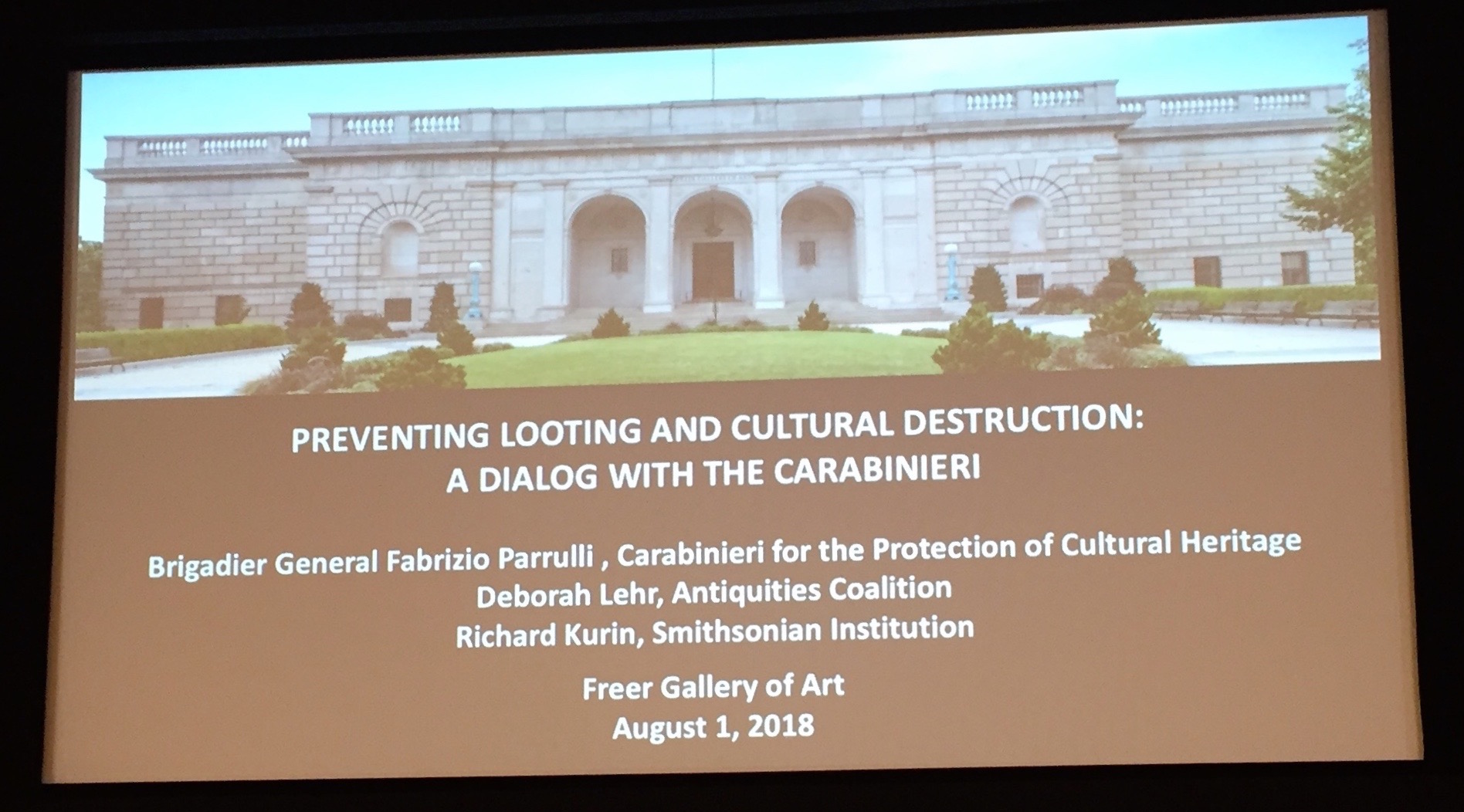
At the Freer Gallery, a seminar on looting of cultural heritage

If you think museums are just homes for great art, think again. The art, academic and museum worlds have combined forces into activism against theft. They have to since the illegal sale of cultural heritages has become endemic. It is also immensely profitable.

At the seminar at the Freer Gallery of Art in Washington D.C. were Acting Director of the Freer Gallery, Dr. Richard Kurin and Brigadier Gen. Fabrizio Parrulli of the Italian Carabinieri.

“Museums have become proactive,” Kurin said, “in conservation and cultural heritage.”

Much of the discussion concerned the recovery of stolen art, either after a natural disaster (think the Haitian earthquake) or war (think Iraq and Syria.) During and after the Iraq war, and in particular, with the advent of ISIS, which is adept at selling items stolen from the lands they held, antiquities have flowed into the market. New York’s Manhattan District Attorney‘s office has a new office devoted to it.

The international coalition seems mostly to be Western: US, France, UK, and more. Unesco has the “Blue Helmets for Culture” group. Parrulli mentioned that they spend time with some of the Special Forces groups going into war zones to make them aware of antiquities they might encounter. (Uh, good luck, antiquities.)

There is also now an Internet app, iTPC Carabinieri, if you run across something you think is suspicious on your summer holiday in Europe.

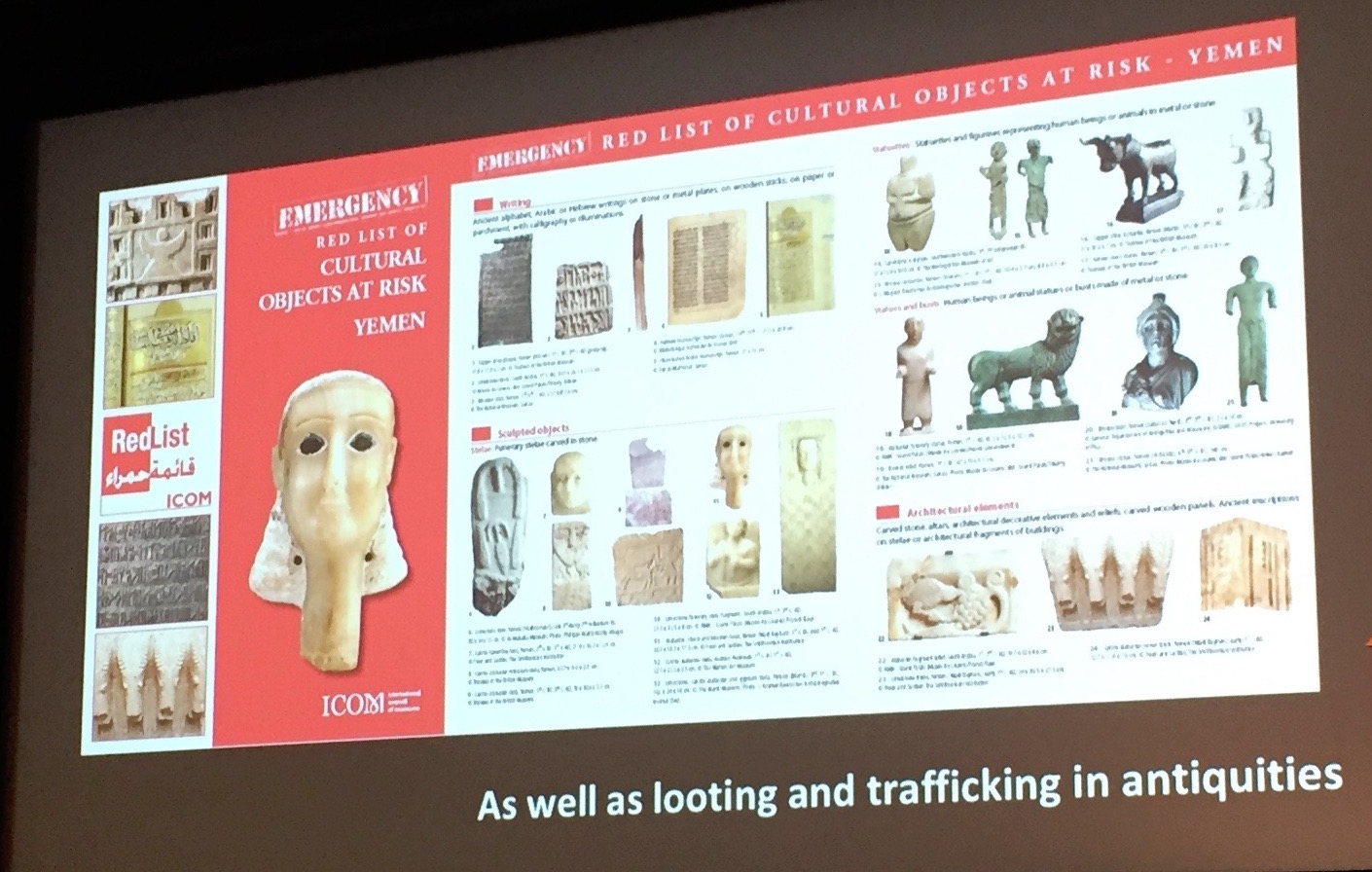
In international efforts, a 2016 conference in Abu Dhabi where there was an effort to create a $100 million fund for “protection of cultural heritage.” Also in 2016 President Obama signed legislation leading to the “Cultural Heritage Coordinating Committee.” This committee lies in the purview of the Department of State along with the Cultural antiquities Task Force, the International Council of Museums’ “Red Lists of Cultural Objects at Risk.”

The Q&A included Deborah Lehr, founder of the Antiquities Coalition, a very accomplished woman. https://archaeology.columbian.gwu.edu/deborah-m-lehr

What I came away with is the belief that there’s a lot of action on the cultural heritage field nowadays, happening under the cover of disinterest.

There were two amusing bits. Kurin mentioned that actor Ben Stiller (star of the Night at the Museum: Battle for the Smithsonian) was now supporting conservation efforts.

The last question, a young man asked Parrulli about the men arrested for art trafficking photographs. What he was asking was the younger generation as prolific in theft as the photographed men, who he referred to as being “in their fifties and sixties, getting elderly…” His question was drowned in laughter.

The average age of the audience was over 50.

Posted in 2018, art, Freer Gallery of Art, History, Uncategorized | Tagged , , , , | Leave a comment

Don’t blink or you’ll miss ‘Artes de Cuba’ at the Kennedy Center

Cuba Celia Ledon

On a trip to pick up tickets at the Kennedy Center, I discovered the Artes de Cuba: From the Island to the World.

For those unfamiliar with the Kennedy Center, the theater along the Potomac River is one of several arts meccas in the Washington D.C. area. It’s usually know by its plays (‘Hamilton’, I’m looking at you) in June and musical offerings, but right now it has sculptures on the main floor, and an extended video and costume exhibit on the terrace level, next to the restaurant.

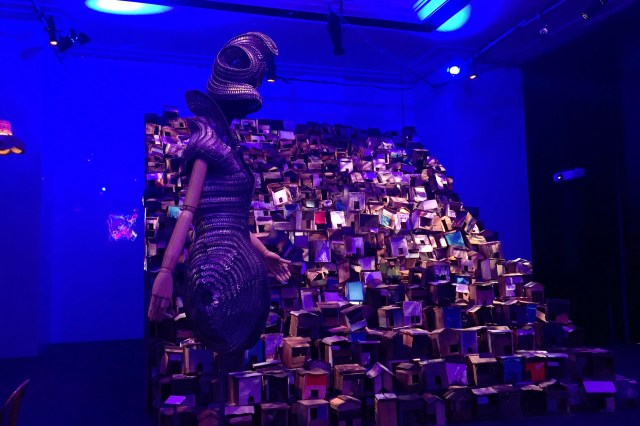
The outer room has a 15 minute video of Cuba’s vibrant buildings from Emilio Perez, but the most stunning part in the inner room are costumes by Cuban artist Celia Ledon.

2018-KennedyCtr-Celia Ledon-12

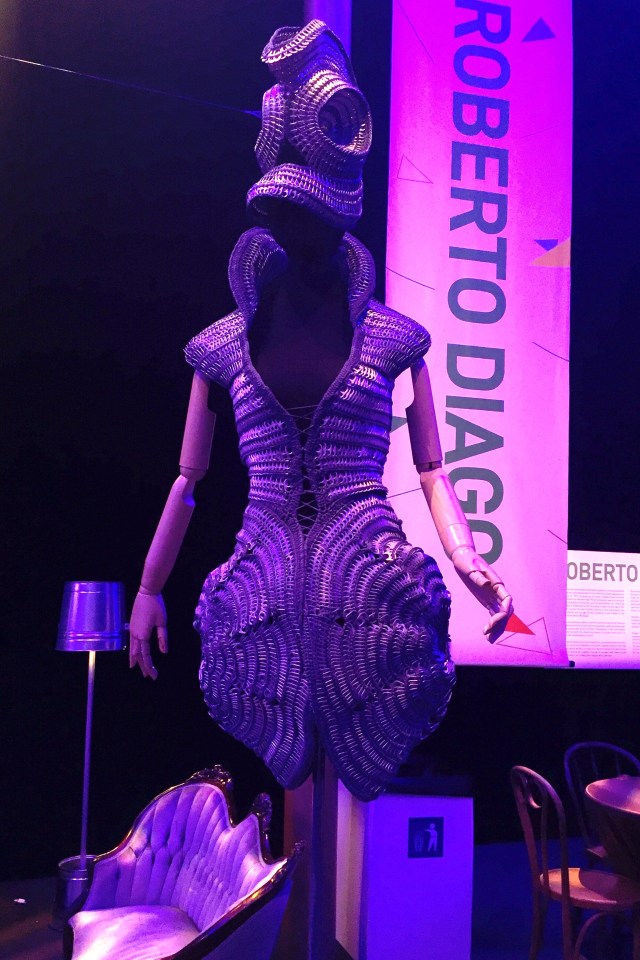
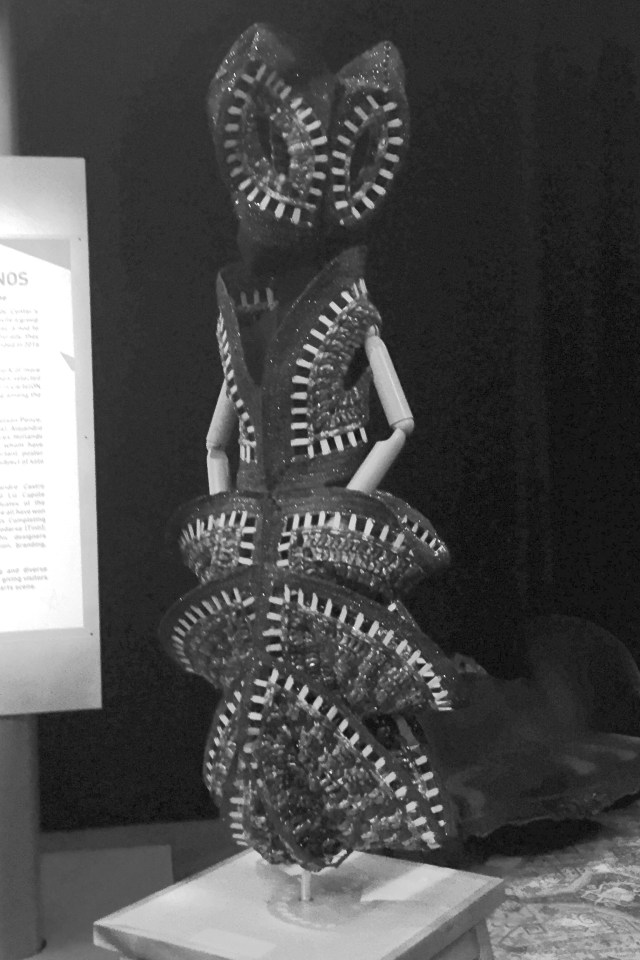
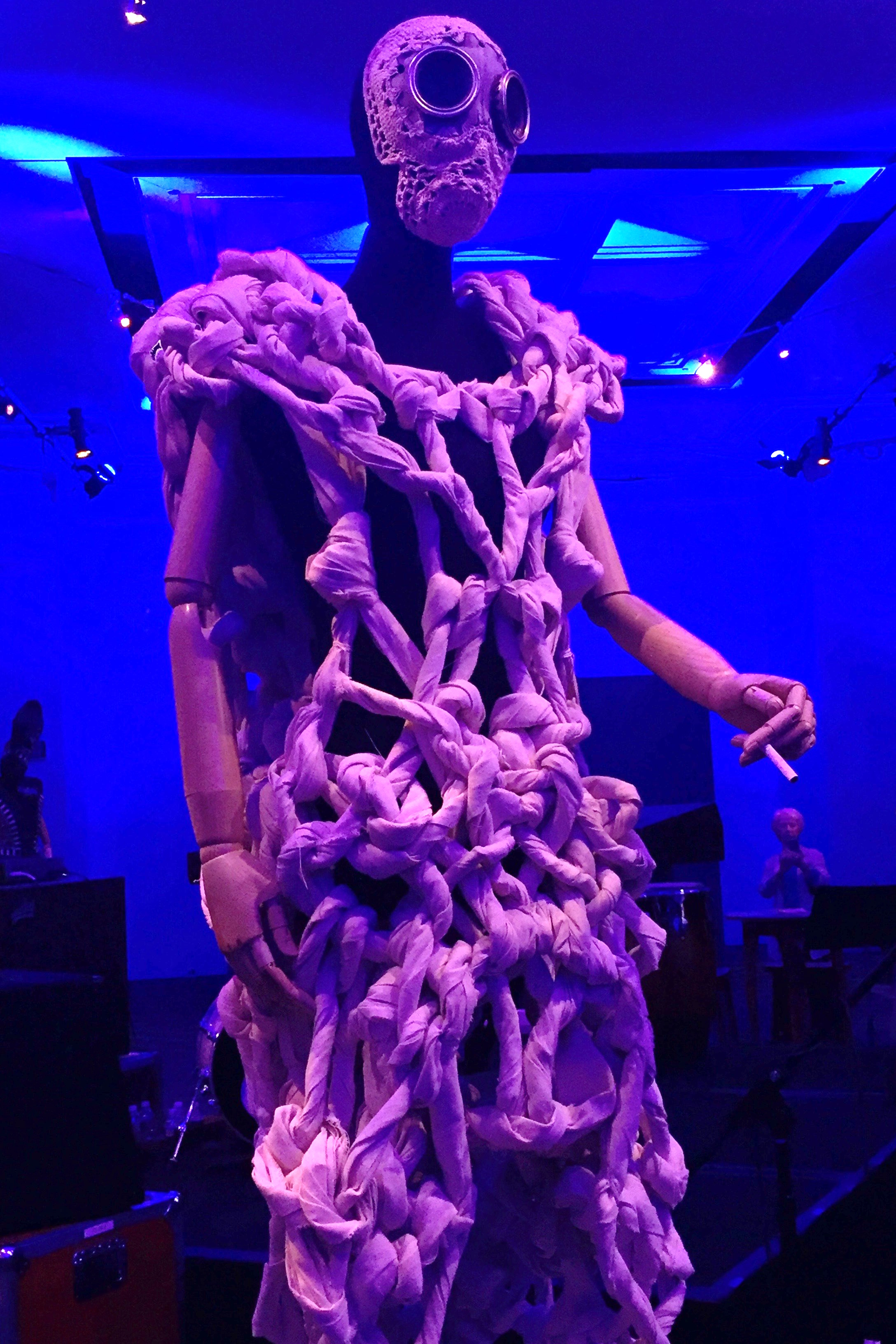
‘The Shining’ is made from pop-top rings crocheted together and tied with strips of lycra.

Her intricate costumes come from “discarded videotapes, pop-top rings and tires”. According to the wall information, she is “obsessed by trash.” With unusual articulated mannequins, her work looks like it comes from science fiction films. In fact, her work has appeared feature films and fashion. At this moment she’s working with the Teatro el Publico Teatro el Publico and Ludi Teatro, whose U.S. premiere was canceled in October 2017 after visa difficulties.

The exhibit is lit with blue light and neon. I converted one of the pictures to black and white so the detail can be seen.

2018-KennedyCtr-Celia Ledon-5

“Photo Sensitive” by Celia Ledon. The photo was converted to black and white so detail could be seen.


The Artes de Cuba runs until May 20, 2018. A pop-up store on the main level of the Center sells bright, Caribbean-patterned scarves and wraps.

2018-KennedyCtr-Celia Ledon-6

A crocheted gas mask tops “Loose Ends” from Celia Ledon. It’s made of raw canvas.


Posted in 2018, art, Costume, Uncategorized | Tagged , , | Leave a comment

Top shopping at the Smithsonian Craft Show

Smithsonian Craft Show

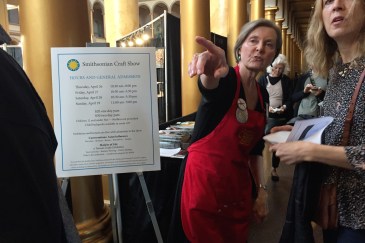
I have seldom walked through a craft show and had my jaw drop at virtually every booth. The outstanding quality and imagination sets the 2018 Smithsonian Craft show at the National Building Museum apart from so many others. It is a stunning show of artistry.

While this year’s theme is Asian Influence / American Design, the work for sale comes from around the world.

(I’ll be linking to websites for the exhibitors since they preferred no photography in the show.) It runs from April 26-29, 2018.

Selected from over a 1,000 applicants, the 120 artists were chosen by a trio of judges,  Bruce Helander, art critic, Jane Milosch of the Smithsonian Provenance Research Initiative and Shoji Satake from the West Virginia University.

In immaculate booths,  ceramics, glass, jewelry, lamps, woodworking and more are displayed. It may sound like a conventional craft show, but there is nothing conventional here. While pricy, what you see and can buy is often one-of-a kind work of art of stunning quality.

Out of  Wilson, Wyoming came stunning hand-blown glass platters and bowls from Thal Glass Studio in vibrant purple and oranges. With steampunk-influenced lanterns, California artist Evan Chambers evokes Jules Verne’s’ Voyage to the Bottom of the Sea in an octopus lamp.

From Peru, Nicario Jimenez invoked the Day out of the Dead in his wall sculptures. Colorful and fascinating. He also won Best of Show.

Jennifer McCurdy’s ceramics may have started life on a potter’s wheel but their porcelain swirling lines, woven texture, and spiky leaves remind you more of wind-sculpted rock or, in one case, magnolia flowers. She’s from Massachusetts.

Zippers as art? Check out Kate Cusack‘s necklaces and pins. She’s one of the many jewelry artists.

If you want handmade unique shoes suitable for the office, try the Cordwainer shop.

Several of the fabric artists channeled the Show’s team of Asian influence. One used Chinese dragons in brilliant red and gold for a swing coat. Susan Bradley out of Minneapolis, Minn. does works with silk and kimono fabrics.  Cathayana from Troy, Michigan has multi-colored accordion-folded scarves.

There seemed an unusual number of ‘decorative fabric artists’ a.k.a. wearable art (think swing coats or filmy hand-painted scarves.)

Sarmite Wearable Art out of New Jersey, has stunningly designed coats. (I have provided a link to a Pininterest page because going to the Sarmite site, I get a list of pills for sale. If you search for them in Google, you probably can reach them through their phone number).

Many of the Show’s artists have donated items for an online auction that runs through May 1, 2018. The proceeds go to grants that the Smithsonian Women’s Committee (SWC) hands out supporting Smithsonian programs, education and research.

The latest set of 17 grants were national and international in scope. Among them, the National Museum of American History got a grant aimed at their digital and video efforts. The Smithsonian Libraries grant went to helping students from DC, MD and VA to help shape “programing” aimed at their peers. The National Zoo got two grants, one for “counting mammal species” in Kenya and the other for a study of the “release of golden frogs from captive care” in Panama.

IMG_7927

Kudos to the Smithsonian Volunteers, including Tia Duer, who worked hard to keep things running the day I went. They were unfailingly helpful.

The Smithsonian Craft Show runs for four days, April 26-29, 2018 at the National Building Museum in Washington D.C. The online auction runs until May 1st.

Posted in 2018, Asian art | Tagged , , , | Leave a comment

A to-be-read book, ‘Darjeeling,’ turns out to be so worth it

IMG_7685 (1)

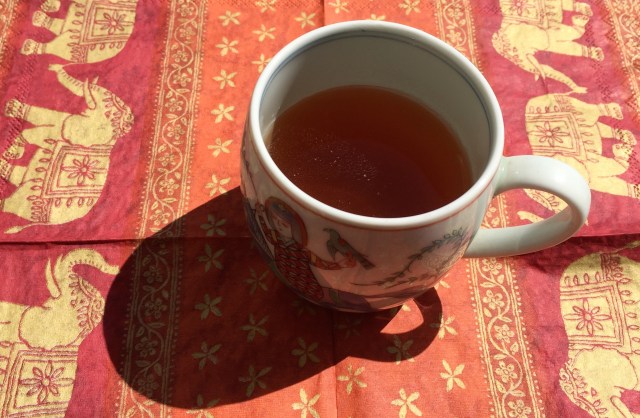
An afternoon cup of tea

Too often books languish in a pile named, “I’ll get to it soon.”

That’s what happened to Jeff Koehler’s “Darjeeling: The Colorful History and Precarious Fate of the World’s Greatest Tea” which has been gathering dust for roughly three years. Yet every time I thought of giving it away, I’d flip it open and fall in love with the writing all over again.

Jeff Koehler, noted food author whose writing has appeared in Food and Wine, the Washington Post, NationalGeographic.com and many others, has written a love song, to the delicately flavored India tea, Darjeeling.

It’s more than a song, it’s an opera. Spending at least a year, and a growing season in Darjeeling, India, Koehler tells the story of how the tea leaves are grown, shipped, and end up in your morning brew. That’s only a fragment of the book though. The rest is a world history of tea, how it came to India,  the influence of the British on colonial India (think Rudyard Kipling’s Plain Tales from the Hills or Paul Scott’s The Raj Quartet); and how things changed – or didn’t – in the tea industry when India’s independence came.

No one can tell a great story like a great writer. In just few words, Koehler can evoke the experience of a taste of an expensive hand-rolled tea, the 2013 Green (tea) Pearls. “He smiled and plucked a couple of rolled pearls the size of earrings from a jar. Once steeped, the liquor shines a pale gold, a shade closer to champagne than hay. In the mouth, it’s plummy in a fulsome and rounded way…”

He goes into the modern marketplace behind the small tea bags that you find in the local grocery or tea shop. By the end of the chapters on picking, rolling and tasting, you might want to know exactly when your tea was picked so you know you are getting the best of that season’s leaves.

Koehler also goes into the problems facing the modern Indian tea industry such as manpower demands, and the vagaries of Mother Nature in regards to rainfall and soil content. The  extensive bibliography at the end can be a jumping off place for more reading.

IMG_7687

Label from the bottom of a container of Darjeeling Tea from India

Being a food writer, he includes some recipes at the end such as how to brew the perfect cup of Darjeeling, Masala and Tibetan Tea with Salt and Butter. If you’re in a Victorian or “British Raj” mood, you might try Timeless Cucumber Sandwiches or Chicken-and-Fresh-Mint Hamper Sandwiches. Or, maybe local favorites such as Momos, Thunkpa or onion Pakoras.

Koehler’s latest book published in 2017, “Where the Wild Coffee Grows: The Untold Story of Coffee from the Cloud Forests of Ethiopia to Your Cup,” which looks to do the same thorough research for the other morning staple for millions.

Tea has a history that spans millennia. Koehler’s “Darjeeling” is a good place to start reading about its past.

I recommend having a full steaming teapot and cup at your elbow, along with some scones with clotted cream, or some tea-marbled deviled eggs, as you begin your journey.

———-

Darjeeling: The Colorful History and Precarious Fate of the World’s Greatest Tea Bloomsbury Books, $26.00

Posted in 2018, History | Tagged , , , | Leave a comment

Ikats! Ubiquitous but unknown

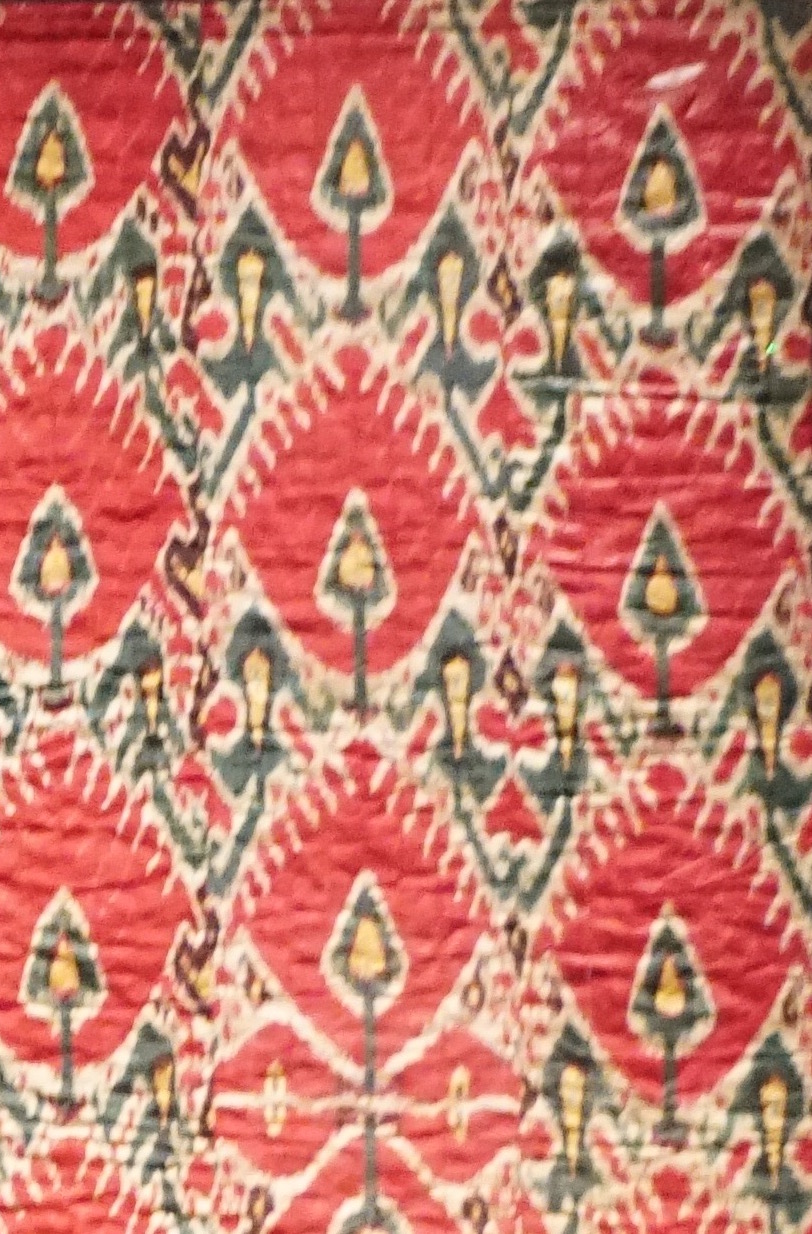
Ikats from “To Dye For” at the Sackler Gallery in Washington D.C.

The next time you hit Crate and Barrel, or Target, take note of the ikat designs everywhere.

If you don’t know what ikats are, go down to Washington’s Arthur M. Sackler Gallery of Art for the new exhibit, “To Dye For: Ikats from Central Asia.” It displays antique robes alongside the work of a Western fashion designer who discovered and popularized the design – Oscar de la Renta.

The word ‘Ikat” is actually a Malaysian-Indonesian word that means “to tie” bundles of thread. It has become a generic term for the designs, said Chief Curator Massumeh Farad, of the Freer Gallery of Art and the Arthur M. Sackler Gallery. “In Central Asia the term  used is ‘Cloud Binding’.” Ikats are produced in India, Indonesian and Japan, but the Central Asian ikats are known for their “incredible color and palette and bold designs.”

The Sackler Gallery had an ikat exhibition in 1998 drawn from the collection of Dr. Guido Goldman. Later he donated 70 textiles to the museum. The museum has drawn from the donation for this exhibit.

Ikat from Central Asia at “To Dye For.”

Farad said that tiny fragments of ikats have been found as early as the 8th century from Yemen but they really flourished in Central Asia from the early 19th century. The ancient “Silk Road” cities of Bukhara and Samarqand became hubs of the textile industry. After Uzbekistan’s independence in the 1990s, there has been a revival of ikat production.

Ikat coats were expensive luxuries usually created for royalty or the rich. In nomadic cultures the vibrant lined coats were one form of wealth. Velvet ikats are “top of the line,” said Farad, since they are so complicated to make. “Ikat velvets are the absolute finest.”

Ikat robe from Central Asia, silk velvet, 1850-75

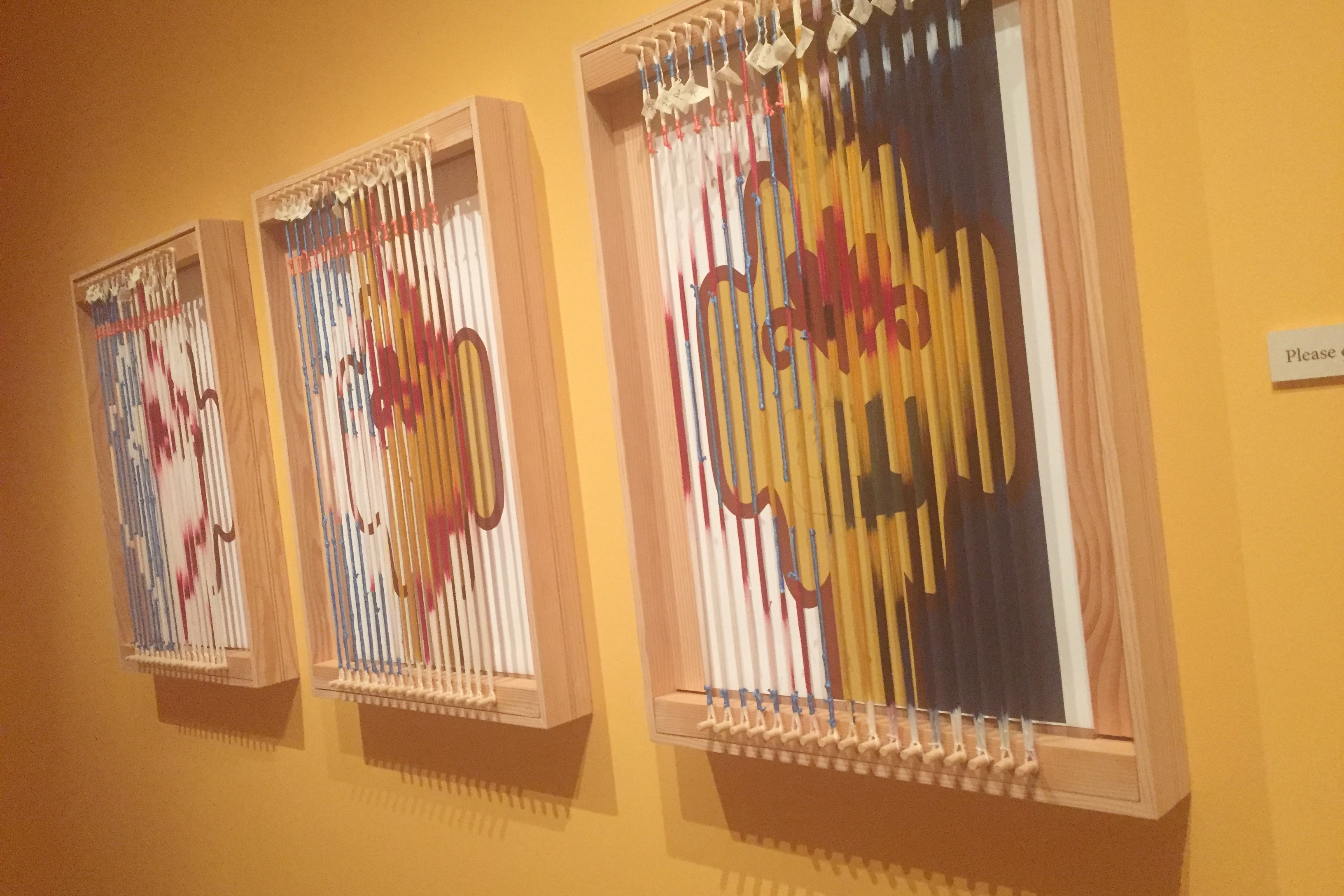
The process of making an ikat is laborious. The designs, with pomegranates, jugs and others, are created long before the actual weaving is begun. The threads are dyed from light to dark, usually starting from yellow to the red to indigo. At George Washington’s The Textile Museum, which also has a ikat exhibit, “Binding the Clouds: the Art of Central Asian Ikat,”  The Maryland Institute College of Art, Baltimore, has constructed several examples of looms strung with dyed yarn which shows the complications of the weaving.

The Maryland Institute College of Art, Baltimore, looms

At the Sackler, Farad explained that the dying and weaving were done by different guilds. The indigo was done by the Jewish community; the Uzbeks “would be weaving the pieces together.”  The hangings were used to separate spaces in a house or to cover things like blankets. When you look at a large hanging, it is easy to find the seams where the shorter ikats were sewn together to make a large one. When they wore out, then fragments could be used as patching materials.

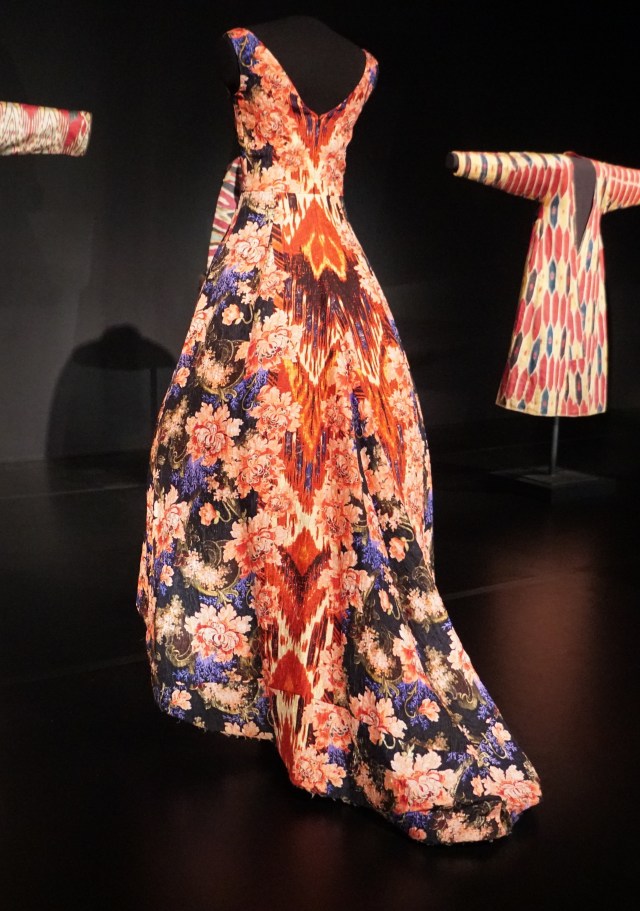
In the late 1990s, Dominican-American designer Oscar de la Renta went to Uzbekistan and was “stunned by the colors and designs,” said Farad. He introduced ikat designs into his clothing in the late 1990s and up to 2013. A dress and several of de la Renta’s ikat-patterned coats are on display alongside with the antique ikats.

2018-freer-ikats-2.jpg

Fall 2013 Oscar de la Renta dress made from silk and wool jacquard using ikat designs.

On April 14, the Textile Museum is holding a “Shop Event: Ikat by the Yard” offering three new custom-designed and handmade velvet ikats from Uzbekistan.


“To Dye For” runs until July 29, 2018 at the Arthur M. Sackler Gallery in Washington D.C.
“Binding the Clouds: The Art of Central Asian Ikat” at The Textile Museum runs through July 9, 2018.

Posted in 2018, History, Sackler Museum | Tagged , , , , | Leave a comment

A ‘March For Our Lives’ in Washington DC

2018-MarchforourLives-7They came from all around the DC area and from out-of-state – Minneapolis, New York State and more. They filled the historic Pennsylvania Ave and overflowed to some of the other streets.2018-MarchforourLives-14

The March for Our Lives was not just teens protesting. it was complete families, from grandmothers in wheelchairs to one-year-olds being fed a jelly sandwich by her mother as her father held a sign saying, “NRA Math. 1 Good Guy with (picture of AR-15) + Bad Guy with (picture of AR-15) equals 2 (picture of AR-15)’s $old.” The child’s sign said, “Gun Reform Now” and had a hand print in one corner and a crayon drawing in crayon.

IMG_7553

It was also one of Washington’s best run protests. The tee shirt vendors were hard at work flogging various versions of the name. Probably the blue-green tie dye shirt was the most exotic. They were hawking diverse offerings including buttons with a banned symbol over a drawing of an AK-15, bumper stickers, and rainbow flags. There were Philly “Real (soft) Pretzels.”

Outside the journalism museum, the Newseum,was a table to make protest signs. On the stones below were slogans drawn in chalk.

2018-MarchforourLives-13

Hail Canada! The Embassy stairs was the perfect place for a photo-op. and many took advantage of it. One woman flew a flag with the iconic drawings from the Women’s March.

2018-MarchforourLives-TopShotOn a street paralleling Pennsylvania, food trucks were linked up awaiting hungry marchers. This is the first time I’ve seen that happen. Usually the hot dog vendors are the saviors of footsore walkers. The restaurants were doing booming business.
DSC02396

The “March For Our Lives” had a fantastic music playlist including Miley Cyrus. I wonder about the choice of “Sympathy for the Devil” by the Rolling Stones, but this is a generation that doesn’t remember the Altamont concert.

The media says there was a counter protest near the Trump International Hotel. The New York Times has an article about these protests  all over the U.S.

This march reminded me of the 2002 march against the Iraq War. Again, the president was out-of-town, and no one came out of the White House to address the crowd. That march failed in preventing the war. Here the President released a statement praising the teens but then his motorcade avoided them in Florida where he was headed for the weekend.

I hope this movement succeeds in producing some welcome change.

Posted in Journalism, Uncategorized | Tagged , , , | Leave a comment

DC’s morning meetings – Pence, Klobuchar

IMG_7208One of the great pleasures of living in the Nation’s Capitol is the chance to seeing  legislators in the flesh and hear their words without any media filter.

This can be good or bad depending on your thinking. If nothing else, you hear tidbits that don’t make into news articles.

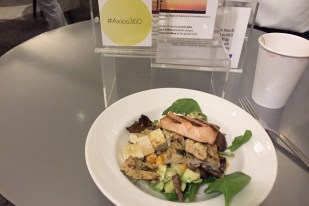
Yesterday, I went to a noon meeting with Democratic Senator Amy Klobuchar and Republican Vice-President Mike Pence at Axios. It was televised on C-Span if anyone wants more detail. In this case they served really good healthy food – salad, salmon, chicken, salad, quinoa, and avocado.

Senator Klobuchar is from Minnesota. She has sponsored the Honest Ads Act along with Senator Warner (Virginia), and Senator John McCain (Texas). She wants online advertisings having to follow the same rules as print ads in transparency. 2018-Axios-Klobuchar.jpg

Just as interesting was her casual comment about applying anti-trust laws to the online travel industry. This would be interesting Unfortunately C-Span doesn’t have a clip on this discussion.

On a lighter note, she’s a supporter of the popular sport of curling.

My interest in seeing Vice President Pence was spurred by many comments by friends which basically demonizing him as a bad man.

That wasn’t the way he came off to me. He was bland and stolid, the perfect balance to the President. Very vanilla pudding without any additives.

He spoke on visiting the Olympics and “ignoring” the sister of North Korean leader Kim Jong Un. “I didn’t avoid the dictator’s sister; I ignored her.” 2018-Axios-Pence.jpg

He went on to discuss the Russian meddling in the 2016 election, repeating twice, at the start and the end that it had “no effect on the 2016 election” and that the intelligence community was “…. confident of the election results of 2016.”  My takeaway: The vice-president doth protest too much. I think the results were indeed skewed by the meddling. Whether it made a difference in the winner, is up for debate (which I am not getting into.)

He was asked what does the media get wrong about Trump? He replied, “The man has a very big heart. (He) loves his family…. Just look at (his) devotion to his family and  his family to him.”

He also he spoke of being upset by comments on the ABC show “The View” which compared “my Christianity with mental illness.” He says he tries to start the day reading “the Good Book” (the Bible) and his “faith sustains him.” He felt that the comments demonstrated how “out-of-touch” was the show was with people.

My takeaway: People need to realize that there’s a human being at the other end of their comments, especially on something as personal to Pence as his religion.

He also said he was a booster about space travel and NASA. “We’re going back to the stars.”

Finally, at the end, in a lighter moment, he says he wanted a motorcycle for Father’s Day since both he and his wife ride them, but instead he got a puppy… which he named Harley.

Posted in Uncategorized | Leave a comment

And… we’ve achieved a new TV

IMG_7148After dragging my friends out to Best Buy and having intense discussions with an employee (which degenerated into an agreeable political discussions because this is the Washington DC area), I ended up with a new television.

What kind? Well, that’s the payoff for reading, isn’t it?

Partly because this is the conclusion of a lesson on how to buy a new TV, here’s what went into the final decision.

I spent at least an hour on Amazon and Best Buy websites, discovering that they both were pushing the 50″ really hard as their Super Bowl sales. Going down to a 49″ or up to a 55″ was hundreds more.

That did make the choice easier. When the cost is exactly the same, then you know what you can buy.

The next question was weight. I admit that after seen the young athletic Best Buy salesman lug it around, I though it would be lighter than it was. Not true. He was just stronger than his lanky build showed.

For $100, I could get the Best Buy Geek Squad to deliver it and set it up. However, that would be a two weeks wait. I ended up having it put in my car trunk, after measuring said trunk to make sure it would fit, I then maneuvering the TV’s box on a cart and wheeled in. It was therefore safely delivered for no cost.

Weight was still a problem in that the old Sharp had to go to another room, then the new television put in its place. A good friend came to my rescue. We moved the old and set up the new one.

By the way, all the measuring of the room’s layout was worth it. The televisions fit exactly where they should go.

So, now what did I get? A 50″ Sony Bravia, 4K HDR.

Oh, you mean after all the angst in the former posting that I couldn’t see the Sony screen because of reflections? Well, the screen’s not shiny enough to reflect, and, besides, I decided that if I had to worry about reflections, I should just get heavier curtains. Easy fix.

Setting it up was fairly easy with the ability to plug in the old DVD player. I dug up the passwords for Netflix and CBS All Access, and they worked. The built-in antenna is helped by the current antenna so I can get stations that had dropped off the old Sharp.

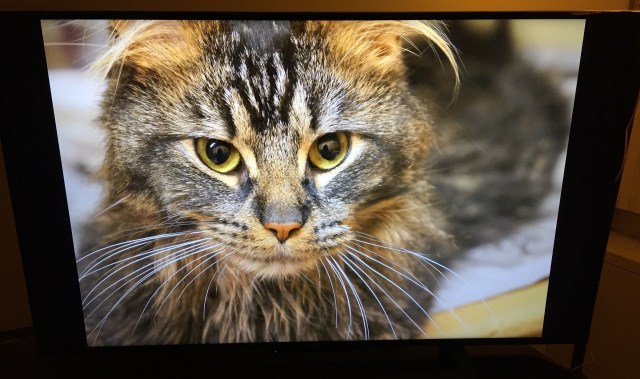
I used the USB to get my cat picture.

So, my new Sony, welcome to the family. I hope to view you for years to come. I even promise to dust you.

(Oh, and the stunning kitty above? His name is Loofa. I hope he’ll get a new human soon.)

Posted in Cats, Uncategorized | Tagged | Leave a comment

The art of choosing a new TV

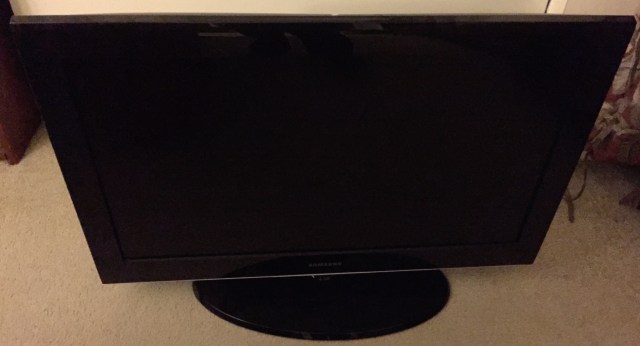
The dead television

Since it’s January, when you’re paying for last December’s frivolity and are looking forward in sick fascination at the upcoming tax season, it’s time for your electronics to break down.

I mean, would they choose to fail in anticipation of Black Friday / Thanksgiving sales? Nah. Or, in time for the under-the-tree Christmas sales boom? Nope. Luckily my television went belly-up just before the final date in sales trifecta: the Super Bowl.

That leads to today’s posting: getting a new TV. 

My elderly (9 years) 32″ Samsung decided to start squealing and give me a green screen of death. It was time to invest in a new set.

That meant facing a maze of choices, only some of them technological. If you are thinking of getting a brand you know, think again. Things have changed in the television marketplace.

First, what are your priorities? I watch over-the-air television, DVDs and Netflix through Apple. Do I need a “Smart” television where I can download apps, surf the web, use as a giant computer monitor, or attach gaming systems? No, but many others do. The manufacturers are trying to be all things to all buyers which means you may get much more than you really want. Frankly, it’s hard to find a 4K television without all sorts of apps being bundled with it, so be prepared.

My first decision? Size matters  (according to trusted sources advising me on Facebook.) Most said, get “the bigger, the better.”

I decided what to do based on, 1) how I will watch the television, and 2) the size of the pace it will go in. (I am not buying furniture to suit the set.) That led to figuring out 49″/50″/maybe 55″ is best for me. The point is to choose the right size for your planned viewing or gaming pleasure. Don’t buy something, then try to plan around it.

I wanted to make sure my current components would work. That meant taking a picture of the back connections so the new machine would also have them. I give kudos to the Sony representative who showed me the back of their set to make sure I could attach the cords.

Component connections

If you don’t have cable or are cutting your cable, you should look into whether the set takes an over-the-air antenna or has a built-in antenna. I found the easiest way of finding this answer was in the comments on Amazon.com where other buyers had asked this question, and gotten answers. Manufacturers don’t mention it.

So where are we? 49/50″ with 4K / UHD. So far, so good.

These sizes are the low end of UHD / 4K televisions according to a couple of salesmen. So, do you choose 1080p, or the upscale 4k / UHD. What is the advantage of 4K and UHD? Beautiful deep blacks and more vivid colors. If you can afford to get it, go ahead. I made that decision which means a higher price.

There are Samsung, Sony, Hisense, LG and Sharp. I currently own an elderly Sharp which I love. However doing my Internet legwork I discover there’s 2017 controversy in the Sharp world. Basically, it scared me off until they figure it out. I don’t know Hisense so I am avoiding it.

As I was perusing the array of sets at Best Buy, I fell in love with Sony. The television’s colors were unbelievable. The pictures glowed. The glass fronts were easy to clean. I was sold. But… I remembered the Sony computer monitor I used to have but (reluctantly) got rid of because of reflections. Placement is important. My living room has lots of light.

So, I walked away from Sony to find a television screen that has a matte or “anti-glare” finish (like my current tv.) I may lose the vivid colors but I will be able to see them. I then discovered that Sony does have “anti-glare” for their larger sets. It’s an additional cost. Hmm. No, it’s too big for the spot. Move on.

A pleasant surprise is that most of the new televisions are lightweight. My deceased 32″ Samsung was heavy. The new Sony 50″ was light, about 25 lbs.

Maybe not last, but important, is price. I discovered that if you’re buying in the “sale season”, the prices of different brands at my size aren’t that different from each other. Look for bargains, online and in stores.

Anyone who hasn’t been shopping with intent to buy a television might be totally overwhelmed at the choices hanging on the walls at Best Buy. I admit that it took numerous trips to understand all the nomenclature.

In November 2017 Consumer Reports did their annual survey. The top ones for my 50″ size were Samsung and LG after I weeded out Sony (sob).

So, now you’ve made some basic decisions, where do you go to buy it? Wal-Mart, Target, Best Buy aren’t your only choices. If you have memberships in warehouse stores, then you might go to Costco (which won’t give you a price online unless you’re a member. Frankly, if I was given a price and I wanted it, I’ll join Costco. As it is, I walked away.) 

Then you have to get it home. The point here is make a decision on how you’re going to get your new television into your residence. If it’s easy for you to bring it home in your car, unpack it, put it on the stand and into place, then plan for that. If you need to have it delivered, you might want buy from Amazon.com or some other choice. Or, you can get Best Buy to deliver it and set it up for you. Maybe even haul away the carcass of the old television. Some cable systems might schedule set-up visits for you.

Once you have the new television home, and set up, you might want to go back to the online comments sections to find how to make the picture what you really want. Gamers want other features than the television-only viewer. If you think what to buy was a cornucopia of decisions, then decided to do with your new “smart” television is going to be worse.

At the end of the day, fulfilling the thought, “I need a new television” isn’t really easy to make any more. You have many decisions to make and many choices after that.

I’ll tell you how it works out.

Posted in Uncategorized | 2 Comments